

The Luv Crafts care ritual
The art of a safer flame.
A sculptural candle asks for a little more attention. Give it the right setting, stay present with the flame and let every burn remain as considered as the object itself.
Begin the ritualBefore · during · after
Three moments.
One considered ritual.
Every Luv Crafts object has its own shape and burn behaviour. Begin with the product page and supplied care card; where they give specific guidance, it takes priority.
Before the flame
Prepare the object.
- Remove every tag, ribbon, bead, string and piece of packaging.
- Trim the wick to approximately 5–7 mm, or follow the product-specific care card.
- Stand the candle upright on a deep, heat-resistant, non-flammable tray.
- Choose a clear, draught-free place away from curtains, shelves, paper, clothing and heat.
- Leave at least 10 cm between burning candles.
While it burns
Stay with the flame.
- Keep the candle within sight from lighting to extinguishing—never leave the room.
- Keep the wax pool clear of wick trimmings, matches, dust and debris.
- Do not move or touch the candle while the wax is liquid or any surface is hot.
- Follow the maximum burn time on the product or care card.
- If the flame grows high, flickers strongly or smokes, extinguish it and use the troubleshooting guide below.
After the glow
Let it rest.
- Use a candle snuffer where possible; do not pour water onto the candle.
- Check that the wick has stopped glowing and the flame is fully out.
- Allow the wax, tray and any container to cool completely before moving them.
- Re-centre and trim the cooled wick before the next burn.
- Store upright in a cool, dry place away from sunlight and heat.

Sculpture meets flame
Wax is meant to move.
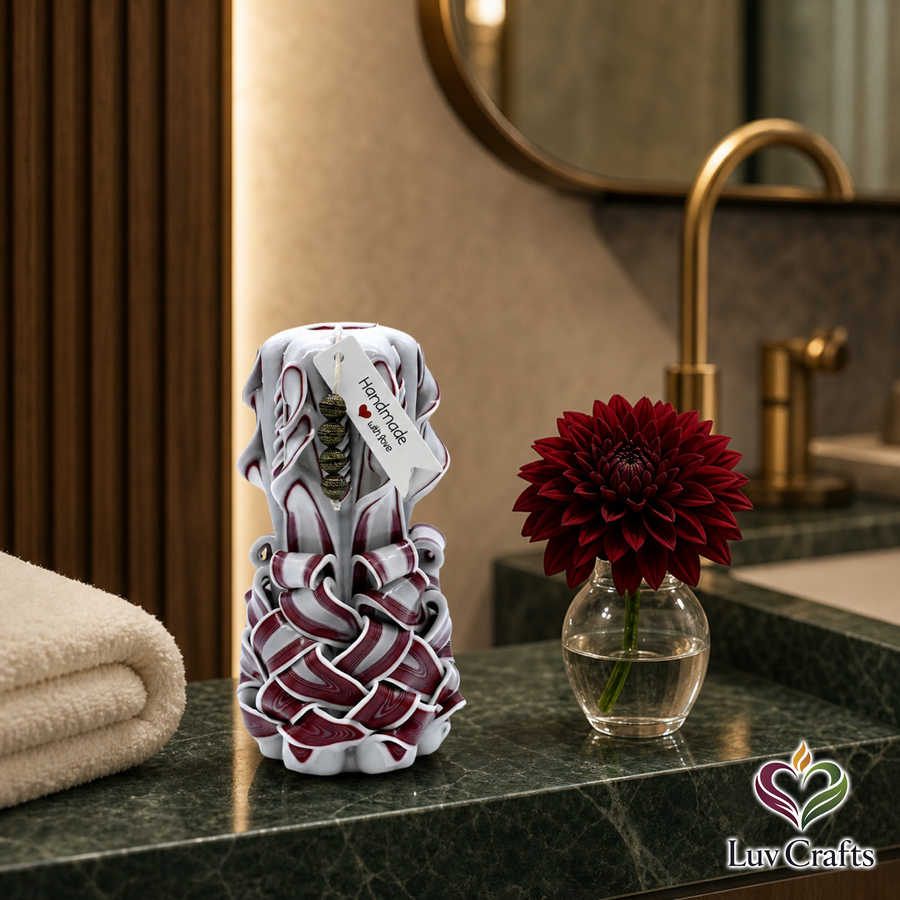
A carved candle will not behave like a simple pillar. Its layered petals and ribbons can soften, open and release wax in expressive, unpredictable paths. That transformation is part of the experience—but it must be contained.
Choose a generous tray
Use a deep, heat-resistant tray wider than the complete sculpture—not just its base.
Keep a clear radius
Wax can travel beyond the original silhouette. Keep the surrounding area completely free.
Observe every burn
Hand-carved forms vary. Stop if the candle becomes unstable or the flame approaches an outer layer.
Read the flame
Your candle is always communicating.
These signals tell you when to pause, cool and adjust.
Tall or restless flame
Extinguish it, allow the wax to cool completely, trim the wick and move the candle away from draughts before relighting.
Smoke or soot
Pause the burn. Check for a long wick, debris, moving air or a flame touching the carved outer wax.
Wax begins to travel
Some movement is natural for sculpture. Confirm the tray is containing it and never touch or redirect hot wax.
The form loses stability
Extinguish immediately. Do not relight a candle that cannot stand securely or whose container is cracked, chipped or damaged.
One object · two lives
Display it—or let it become light.
There is no wrong choice. Decide what you want the piece to become before the first flame.
Non-negotiable
Six things a flame should never meet.
- 01
An empty roomExtinguish before leaving—even briefly—or before going to sleep.
- 02
Children or petsKeep candles, matches and lighters completely out of reach.
- 03
A moving surfaceNever place a candle near an edge, on an unstable base or where it can be knocked.
- 04
Anything flammableKeep the flame away from curtains, flowers, decorations, paper, hair and clothing.
- 05
Water or forceDo not pour water on the candle or blow aggressively; hot wax can splatter.
- 06
A damaged vesselNever light a candle in a cracked, chipped or heat-damaged container.
A calm answer, when you need it
Care questions, clearly answered.
Open the question that matches what you see.
Why is my sculptural candle dripping?
Carved outer layers have different thicknesses and can soften at different moments. Some wax flow is natural. Keep the candle on a deep, heat-resistant tray, maintain a clear area around it and never handle hot wax.
Can I relight it after the form has changed?
Only if it remains upright and stable, the wick is accessible and centred, and no flame can reach loosened decorative wax. If you are uncertain, stop using it and send the atelier a photograph.
What if the wick develops a mushroom shape?
Extinguish the candle, let it cool completely and remove the enlarged carbon tip. Restore the wick to approximately 5–7 mm before the next burn.
Can I remove or pour away warm wax?
No. Do not touch, scrape, pour or redirect liquid wax. Let it cool and solidify completely. Never pour wax into a sink or drain.
When should I stop using the candle?
Stop if the sculpture becomes unstable, a container is damaged, the flame approaches the base or outer wax, or the product-specific minimum wax level is reached. Safety always comes before extending burn time.
Beyond the candle
A safer home completes the ritual.
- Keep working smoke alarms on every level of your home and test them regularly.
- Keep exits clear and never place burning candles in an escape route.
- Make sure everyone at home knows how to leave safely in a fire.